




Leave feedback on the product


AH3-2 24 V DC / 6 sec time relay with DIN rail mount

Shipping costs are not included in the price.
Shipping costs are not included in the price.
Product code: P-CZAS-0019
Share the product card


Ask about the product
The personal data controller is Graf-Art Sławomir Kulbida. We process it to respond to the inquiry. More information about the processing of personal data can be found in the privacy policy.

AH3-2 24 V DC / 6 sec time relay with DIN rail mount
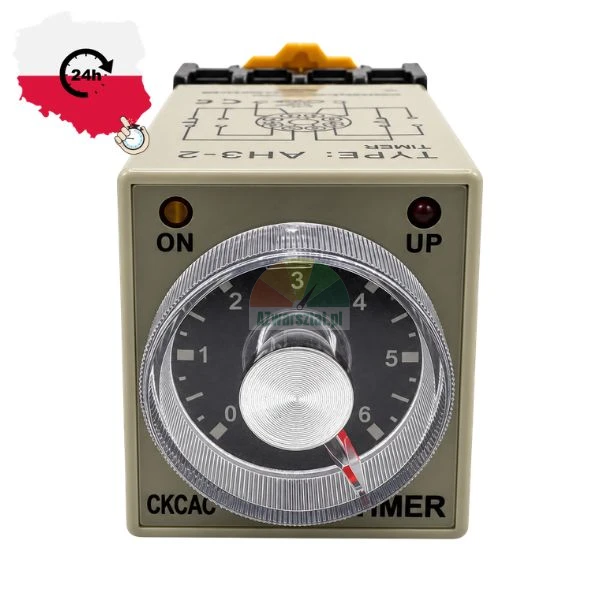
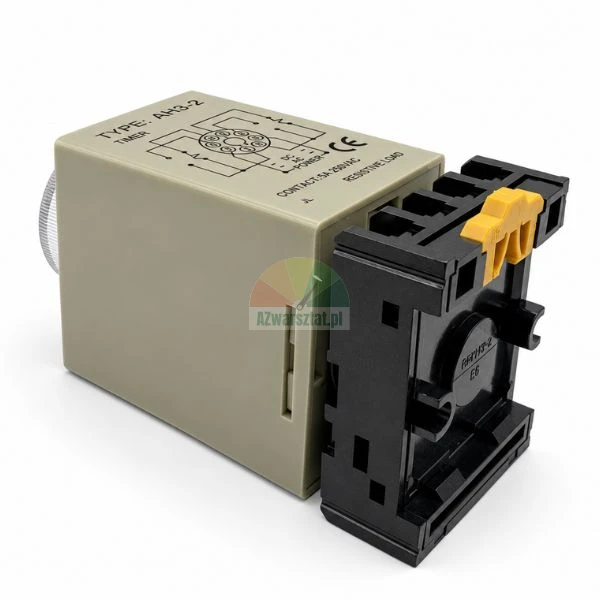
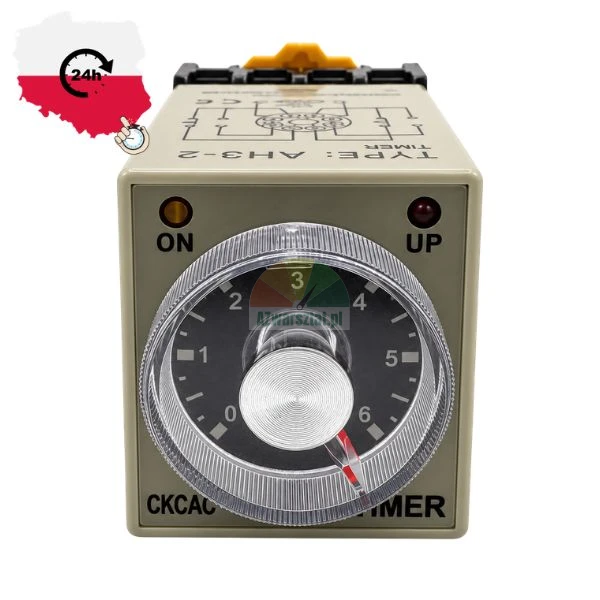
The AH3-2 relay is used to switch two circuits approximately 6 seconds after the supply voltage is applied. In a control system, it can delay the activation of a subsequent component, e.g. a contactor, solenoid valve, intermediate relay or control signal.
This model is designed to operate at 24 V DC. The relay has two changeover contact sets, which means it can simultaneously open a normally closed circuit and close a normally open circuit. In workshop machinery of this type, the relay can be used in the control circuit of a lift, a mounting jig or a balancing machine, but its application depends on the specific machine’s circuit diagram.
Technical data
| Type | AH3-2 |
| Supply voltage | 24 V DC |
| Delay time | 6 seconds |
| Contact configuration | 2 changeover circuits |
| Contact rating | 5 A / 250 V AC for resistive loads |
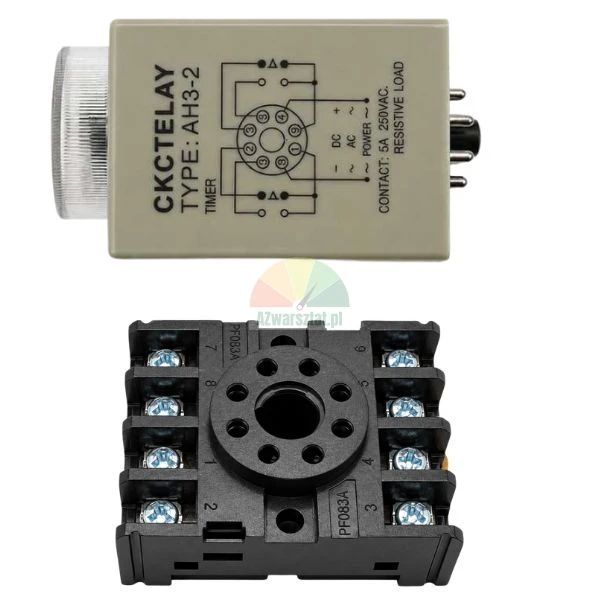
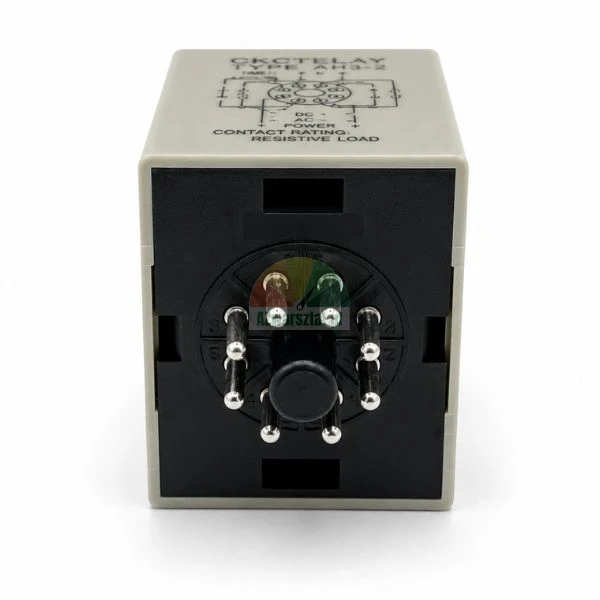
| Connection | 8-pin relay socket with screw terminals |
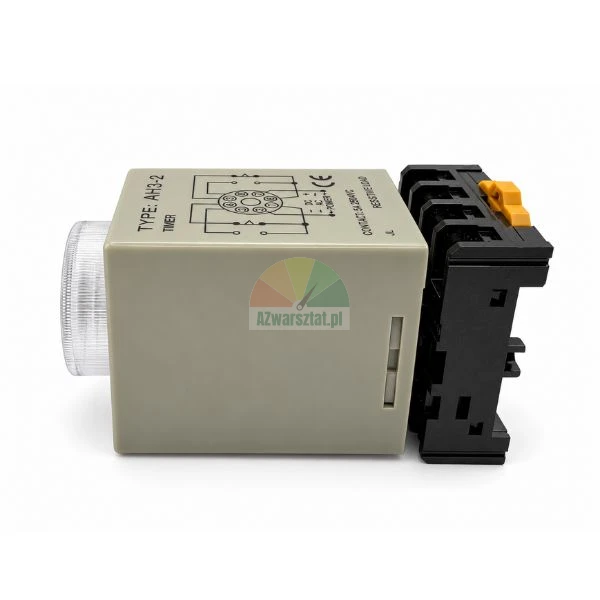
| Installation | Socket designed for DIN rail mounting |
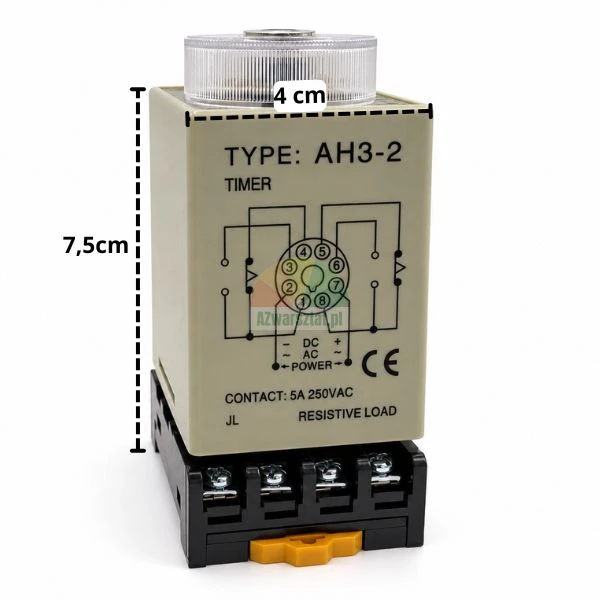
| Relay housing dimensions | approx. 40 × 75 mm |
Terminals and operation
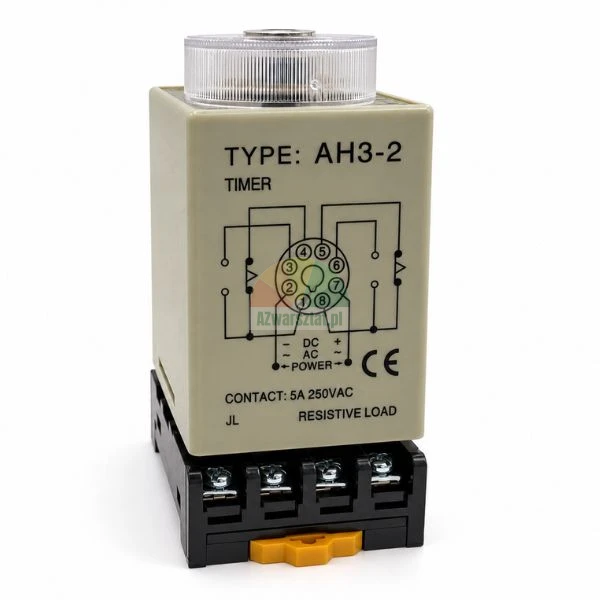
In accordance with the manufacturer’s diagram printed on the housing and the relay documentation, the power supply is connected between terminals 2 and 7. For DC power supply, observe the polarity: terminal 2 is marked ‘–’ and terminal 7 is marked ‘+’.
- 2–7 – 24 V DC relay power supply,
- 8–5 – normally closed contact of the first circuit,
- 8–6 – normally open contact of the first circuit,
- 1–4 – normally closed contact of the second circuit,
- 1–3 – normally open contact of the second circuit.
When connecting: the numbering is shown on the relay and socket diagrams. Do not select terminals solely on the basis of their position on the socket, as the relay may be rotated relative to the view of the wires.
Once power is applied, the circuit counts down the set time and then switches both contact circuits. In the 6-sec version, this time is approximately 6 seconds. If the relay is used to control the operation of an actuator or motor, it should switch the control circuit of a contactor or an intermediate relay, rather than directly switching a load with a high inrush current.
What to watch out for in the control circuit
The rating of 5 A / 250 V AC stated on the housing applies to a resistive load. It should not be regarded as the permissible current for a motor, contactor coil, solenoid valve or transformer. Inductive loads cause sparking at the contacts during disconnection, which may lead to them burning out, sticking or losing their ability to switch reliably. In such a circuit, the relay should control an intermediate component, and the coil circuit must be protected in accordance with the machine’s circuit diagram.
In 24 V DC installations, coils without surge suppression are particularly hazardous to the contacts. Initial signs of their effect on the relay may include unstable switching, the contact occasionally remaining in its previous state, or a noticeable delay differing from the nominal 6 seconds. If the relay is operating in the coil circuit of a solenoid valve or contactor, it is worth checking for the presence of a surge suppression component as specified by the machine manufacturer.
Contact wear often manifests itself earlier as a voltage drop across the engaged contact rather than as a complete failure. In practice, this can cause coils to dim, the contactor to hum, intermittent controller errors or the 24 V system to reset automatically. Voltage measurements should be taken under actual load, not just with the load disconnected.
Before replacement, it is advisable to check not only the 24 V DC voltage but also the timing function and contact configuration. The AH3-2 relay is not a replacement for the single-circuit version or for a relay providing a turn-off delay.
Installation and operation
The relay is inserted into an 8-pin socket, and the wires are connected to the socket’s screw terminals. This design allows the relay itself to be replaced without unscrewing the wires from the control cabinet. The socket is mounted on a DIN rail in such a way that the wires do not exert lateral pressure on the relay body and its socket.
Before commissioning, check that the voltage in the machine is indeed 24 V DC, and also that the circuit uses NO or NC contacts in accordance with the diagram. Reversing the polarity of the DC power supply may prevent the system from operating correctly, and connecting the terminals in the wrong order may cause the relay to operate at the wrong stage of the machine’s cycle.
Product safety
Responsible person in the EU
Graf-Art Sławomir Kulbida
ul. Bolesława Chrobrego 38/5
59-700 Bolesławiec, Poland
Opinions
If you've added a review and it doesn't appear on the list, it may be pending moderation.
Leave feedback on the product
Do you need help?

Go to the blog.
Talk to our customer service team.
Monday to Friday from 9:00 AM to 3:00 PM.
Frequently Asked Questions
What cables do I need for my two-post lift?
Check the rope termination. If there are any markings on it, the total rope length is very often indicated as well, e.g., L8920. This means the rope length is 8.92 m.
Additionally, to correctly select the rope, you need to provide the following technical parameters:
- Rope diameter – measured in the middle section (e.g., 8 mm, 9 mm or 10 mm)
- Thread – diameter (e.g., M16)
- Thread – length – length of the threaded section (e.g., 14 cm)
The drawing below shows the parameters that must be provided when ordering the rope:
What is my machine's model?
- Find the nameplate on the device – it usually contains key information, such as:
- Manufacturer
- Device model
- Year of manufacture
- Serial number
- If you cannot find the nameplate and do not have the technical documentation, selecting parts based on the model may be difficult. In this situation, we recommend searching for parts by category, photos, and dimensions, which often allows you to precisely match the correct component.
Can I return or exchange the part if it doesn't fit?
If the ordered part doesn’t fit, you can return or exchange it within 30 days of the purchase date.
For the return to be accepted, the part must:
- be unused and undamaged,
- show no signs of installation,
- be sent back in its original or appropriately secured packaging.
We care about your shopping experience, so the return process is quick and hassle-free. If you have any doubts, contact us – we’ll be happy to help you choose the right part or guide you through the return process.

