




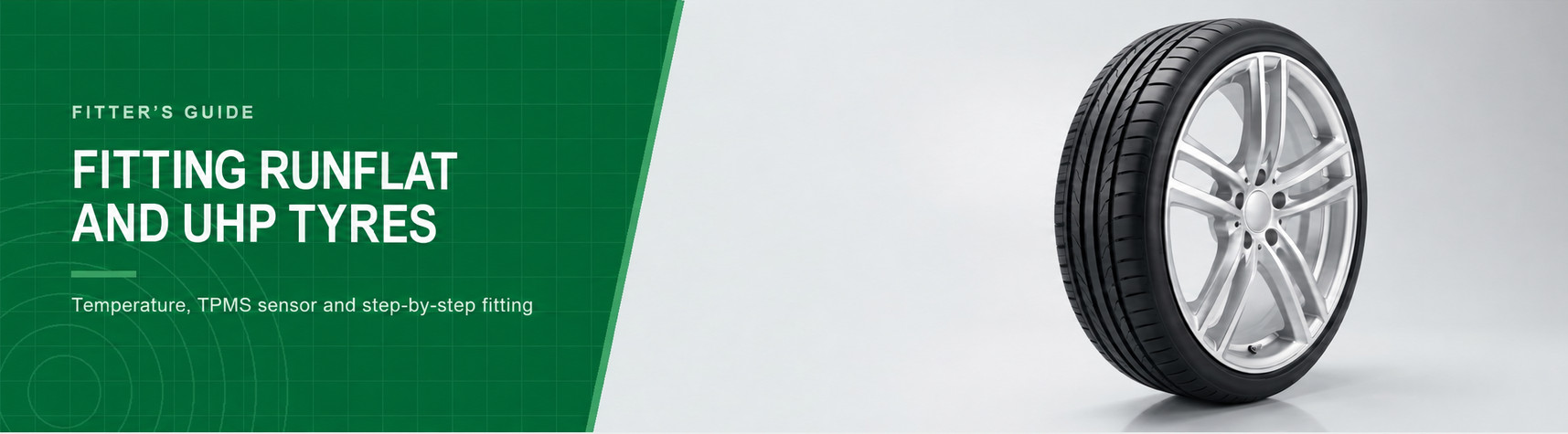
How to fit Runflat tyres and UHP tyres – step-by-step guide for tyre shops
In a tyre shop, a stiff Runflat bead, low-profile UHP casing or misplaced TPMS sensor can turn a routine tyre change into costly damage. This guide explains how to fit Runflat tyres, choose the right rim and tools, protect the sensor, and control temperature, so you can work safely and avoid common fitting errors.
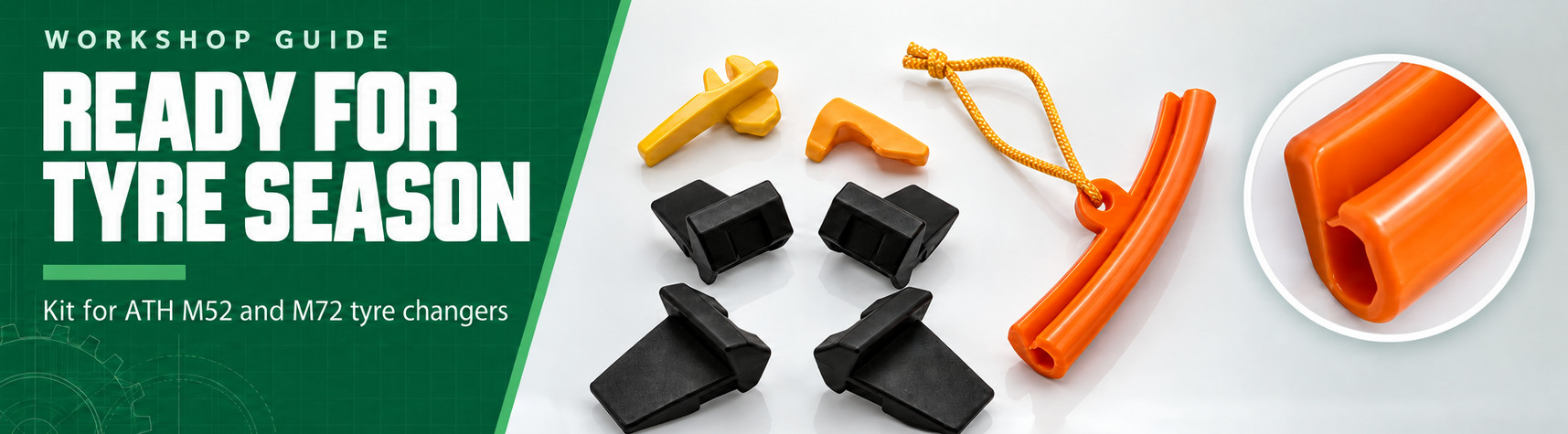
ATH-Heinl M52 M72 tyre changer service kit
Before the autumn–winter rush, worn covers on an ATH-Heinl tyre changer can leave alloy rims exposed to scratches and edge damage. The ATH-Heinl M52 M72 tyre changer service kit replaces key protective components, and this article explains its contents, compatibility and pre-season checks.

Replacing the microswitch in a tire changer joystick — how to fix the controls for a few euros instead of buying a new joystick
Has the joystick on your truck tire changer stopped responding in one direction — no movement to the left, or the arm no longer lifts? In most cases all you need is to replace the microswitch in the tire changer joystick, not to buy the complete control module. The difference in cost is dramatic: a new joystick for an tire changer costs even 100€ gross, while a single microswitch costs a few euros. Below we explain what is actually inside the joystick, how to work out in five minutes which part has failed, and what to look for when ordering a replacement.

Repairing the Bead Breaker Cylinder on a Tire Changer - Fault Symptoms and Seal Replacement Step by Step
According to our sales statistics, the bead breaker is the part that fails most often on tire changers. No surprise there - it is a large, wide pneumatic cylinder in which enormous forces are at work and through which a great deal of compressed air flows. The good news is that repairing the bead breaker cylinder on a tire changer is simple and in most cases comes down to replacing the seals on the piston and piston rod, or swapping out the quick exhaust valve. In this article we show you how to recognize the fault, where exactly the seals sit, and what to replace so the bead breaker regains its full force.

Where Are Tire Changers Manufactured? What the Manufacturer Won't Tell You
The question "where are tire changers manufactured" seems simple – after all, the machine carries the logo of a well-known, often Italian brand. The reality is quite different: the vast majority of budget passenger-car tire changers sold in Europe are made in China today – including many machines offered under European brand names. In this article, we show where genuine European production has survived, how to identify the real country of origin of your machine from the nameplate and the CE Declaration of Conformity, and – most importantly for your wallet – why spare parts for tire changers of different brands are often interchangeable.

Car lift slider blocks - when to replace them and how to spot wear
Is your car lift carriage jerking, making noise or jamming when lowering? The most common cause is worn slider blocks - and in summer, when the heated-up column increases the clearances, the symptoms are at their worst. We show you how to check the carriage play in 5 minutes without taking the lift apart, how to recognise worn slider blocks, what the replacement looks like step by step, and when it pays to replace them preventively - before the column suffers.
Snapped cable on your car lift? Here's how to order a new one in minutes...
Every mechanic knows the sight: a two-post lift with a car up top drops onto its safety latches because a cable on the car lift has snapped. The vehicle is stuck, the bay is dead, and you're losing time and money. The second, equally common case: the cable is due for preventive replacement, but the manufacturer disappeared years ago and the model is two decades old. In both situations one thing matters most — getting the right cable as fast as possible. Here's how to do it without hours of calling around suppliers.
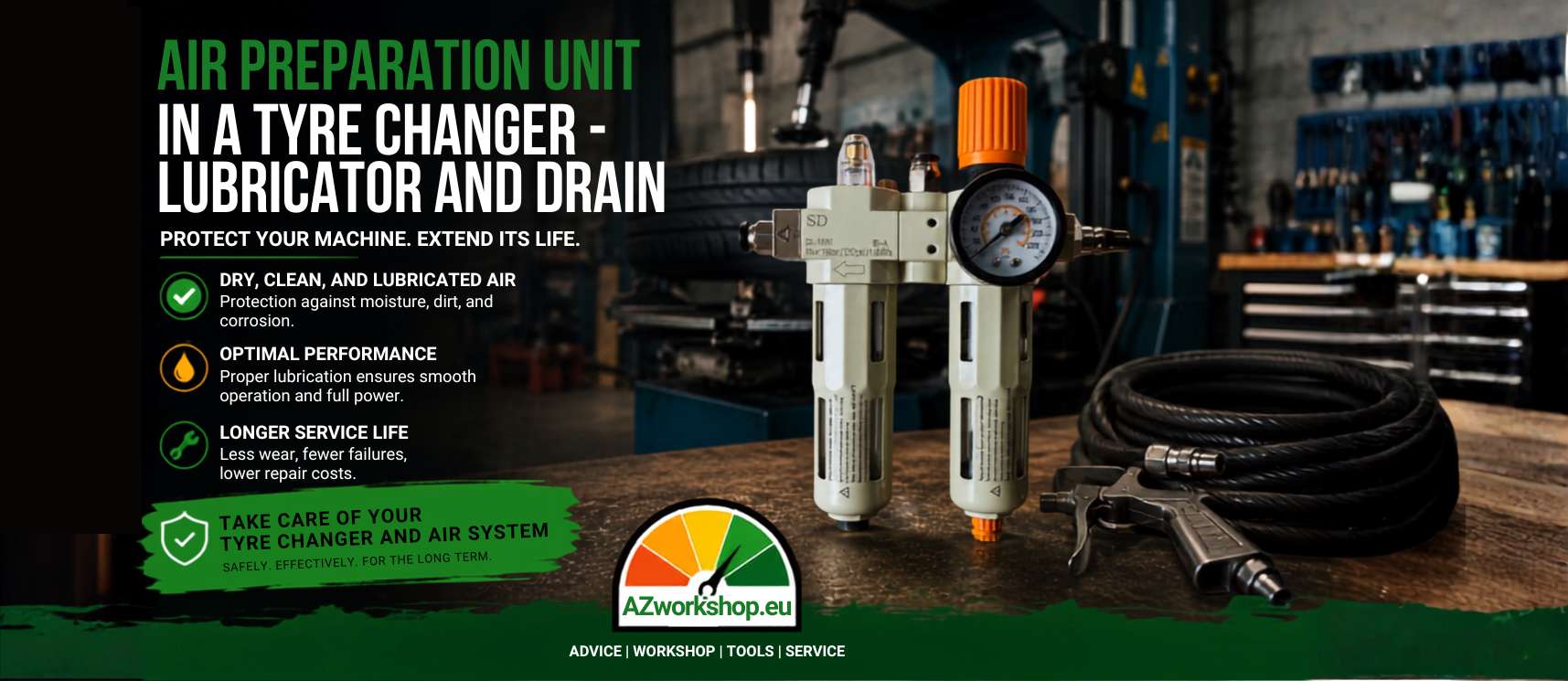
Air preparation unit for the tyre changer — how the water separator and lubricator work
A tyre changer runs on compressed air, and straight from the compressor that air is wet, dirty and unlubricated. An air preparation unit — with a water separator, pressure regulator and lubricator — dries, cleans and oils the air before it reaches the machine.
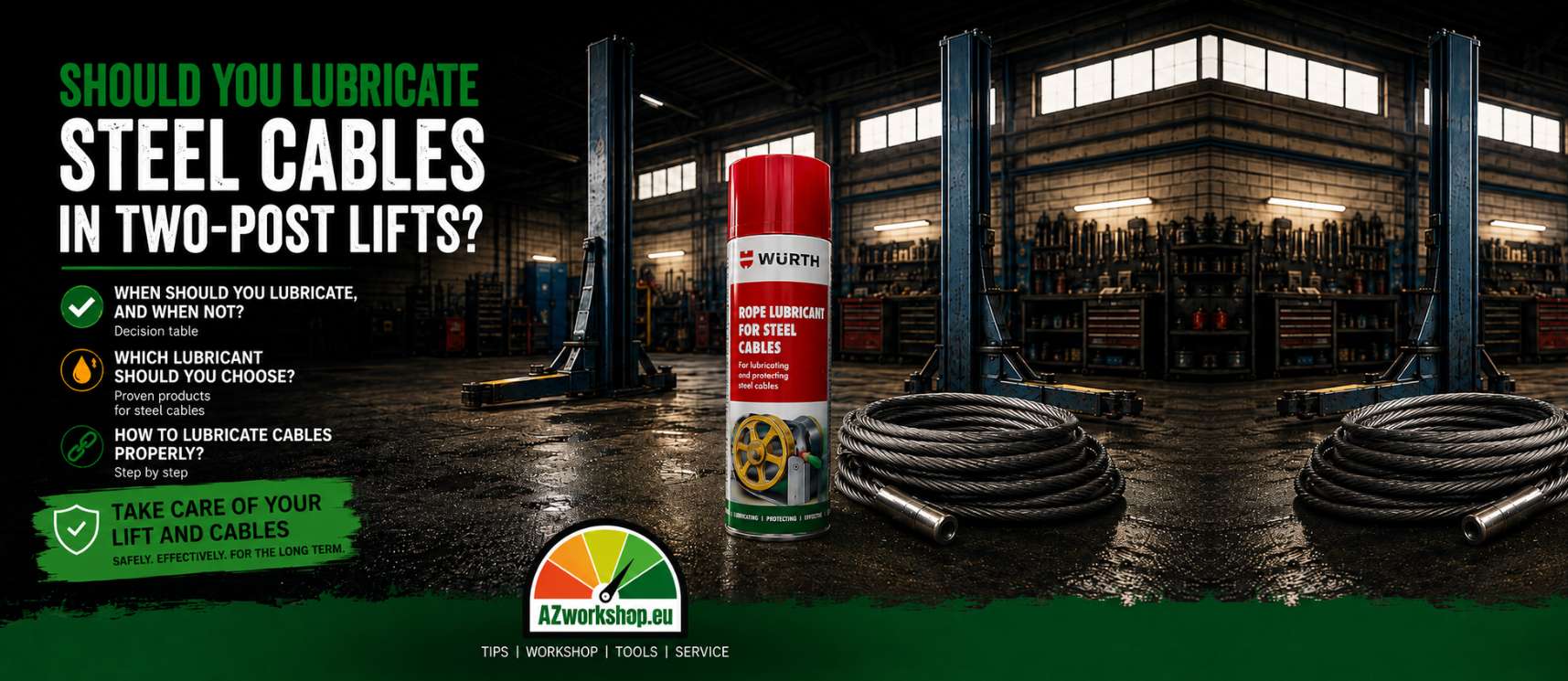
Should steel cables in two-post lifts be lubricated?
In most cases you don't need to lubricate the steel cables in a two-post lift. If the cables work in dry conditions, with no standing water under the channel, they last up to 15 years with no maintenance at all. Lubrication only makes sense when the lift is connected at the bottom and the cables are in constant contact with moisture — and in that case you use a penetrating wire-rope lubricant, not ordinary machine grease.
Two-post lift lowering speed adjustment
Your two-post lift lowers too fast or too slowly? On most lifts you can correct it yourself with one screw on the flow control valve. Here is how to do it safely, step by step.
When to replace the cable in a two-column lift?
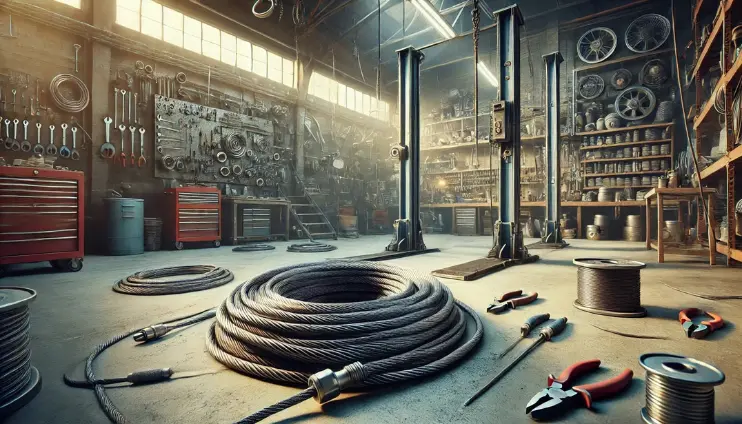
So what is the lifespan of ropes?
The simplest way to express it would be: 'It depends on how a person takes care of the ropes and the conditions in the workshop (e.g., moisture in the lower cover of the ropes), but the average lifespan of a rope is about 5 years.