




In most cases you don't need to lubricate the steel cables in a two-post lift. If the cables work in dry conditions, with no standing water under the channel, they last up to 15 years with no maintenance at all. Lubrication only makes sense when the lift is connected at the bottom and the cables are in constant contact with moisture — and in that case you use a penetrating wire-rope lubricant, not ordinary machine grease.
- added: 31-05-2026
- in category Car lift
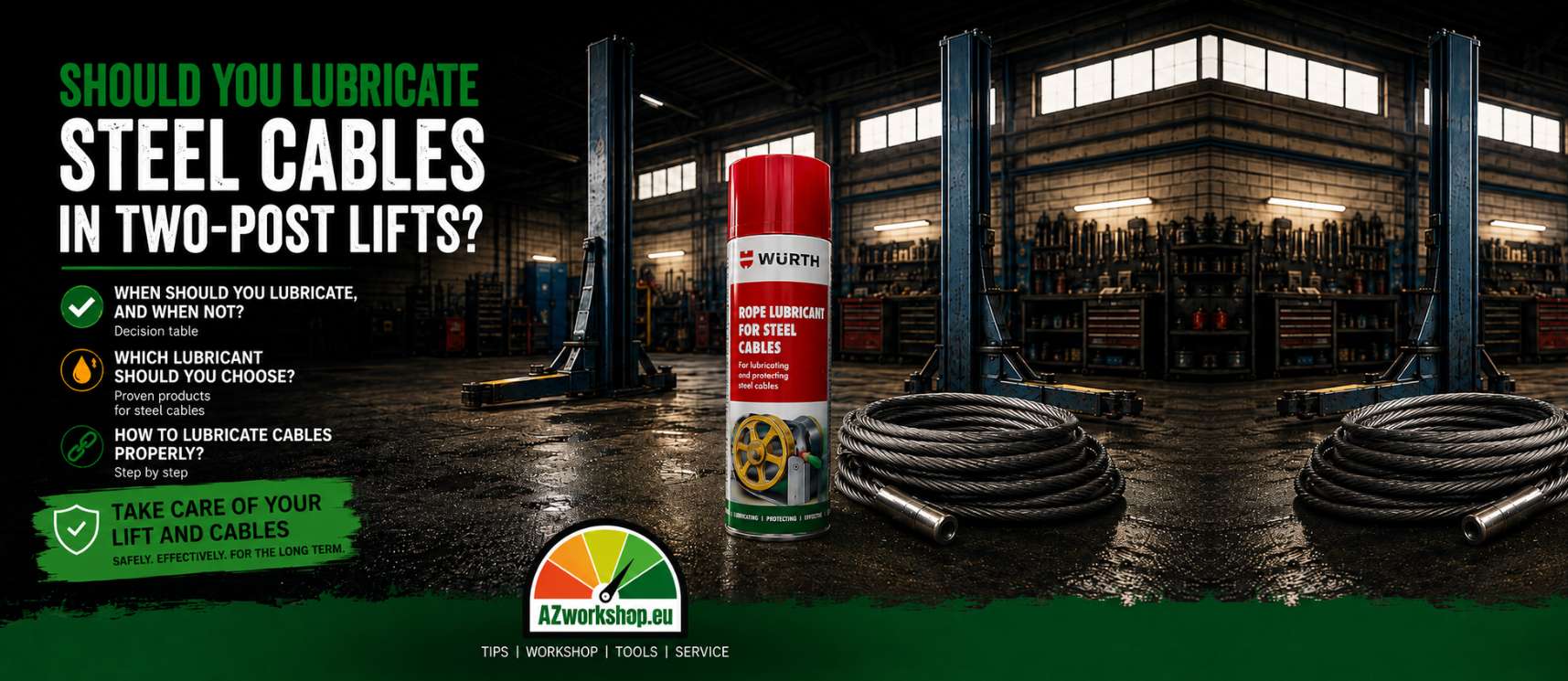
Should you lubricate steel cables in two-post lifts?
In most cases you don't need to lubricate the steel cables in a two-post lift. If the cables work in dry conditions, with no standing water under the channel, they last up to 15 years with no maintenance at all. Lubrication only makes sense when the lift is connected at the bottom and the cables are in constant contact with moisture — and in that case you use a penetrating wire-rope lubricant, not ordinary machine grease.
In this post you'll find a clear decision table (lubricate / don't lubricate), a list of proven products, and the factor that really affects cable life — the conditions under the channel.
Two schools of thought: lubricate or leave dry
Two conflicting opinions circulate in workshops, and both have a rational basis.
The "don't lubricate" school: grease attracts sand, salt and fine debris from the workshop floor. It forms an abrasive paste that, instead of protecting the cable, grinds its wires from the outside and accelerates wear on the pulleys.
The "lubricate" school: grease slows corrosion and extends the life of the cable, especially where moisture is present. Without protection the cable rusts from inside the strand and breaks much sooner.
Both schools are right — but each in different conditions. So before you lubricate anything, read the operating manual for your lift. The manufacturer often states outright whether the cables must not be lubricated (some top-connected designs) or, on the contrary, require periodic maintenance. If there is no manual, or it doesn't cover the topic, follow the table below.
When to lubricate and when not to — decision table
| Lift type and conditions | Lubricate the cables? |
|---|---|
| Top-connected lift | No. Cables routed through the top crossbar are not exposed to moisture. |
| Bottom-connected lift, dry conditions under the channel | No. Without moisture and standing water, cables don't corrode. |
| Bottom-connected lift, moisture / standing water under the cover | Yes — consider a penetrating lubricant. |
💡 Tip: Under normal conditions (dry shop, clear drainage, no salt or sand under the cover) steel cables in a two-post lift comfortably last up to 15 years without lubrication.
Why moisture under the channel is a common problem
The worst-case scenario recurs in workshops with an enclosed channel — especially one tiled over. In winter, cars bring snow, salt and water into the shop, which drains into the channel with no way to evaporate. The cable running along the bottom is effectively standing in brine.
Salt + water + no ventilation = accelerated corrosion of the strand, which is invisible from the outside until the cable starts to break.
Which lubricant to use on steel cables in a lift
If you decide to lubricate, ordinary machine grease is out. It doesn't penetrate the cable core and washes off at the first contact with water — so it effectively protects nothing.
You need a penetrating wire-rope lubricant that:
- ✅ penetrates the strand, between the wires
- ✅ displaces water
- ✅ is resistant to wash-out
- ✅ has good adhesion — doesn't run off or fling away as the cable moves
- ✅ contains anti-corrosion additives
Proven products for steel cables
Dedicated products that genuinely meet the criteria above:
- Würth Rope Lubricant — wire-rope lubricant, penetrates the strand, waterproof
- Motorex Wire Rope Lubricant — a typical product for load-bearing cables
- Brunox Turbo-Spray — penetrates, displaces water, lubricates; popular and widely available in Poland
- Liqui Moly Drahtseil-Spray — forms a flexible, water-resistant film
⚠️ Note: don't use WD-40 as the final cable lubricant. It's a penetrating cleaner — great for dissolving rust and displacing water, but it leaves no durable lubricating film and evaporates. After WD-40 you apply the proper cable lubricant.
How to apply the lubricant correctly
- Lower the lift and make sure there's no car on it.
- Clean the cable — wire brush, cloth, or a blast of compressed air.
- Dry the strand — lubricant applied to a wet cable will trap water inside.
- Apply the penetrating lubricant evenly along the entire working length of the cable.
- Run a few up-and-down cycles without load so the lubricant spreads over the pulleys.
- Wipe off the excess on the outside — that's what attracts sand.
Water under the channel is a bigger problem than no lubricant
With a bottom-connected lift where water constantly stands, lubrication alone treats the symptoms. The main cause of corrosion is water — and no lubricant will stop that in the long run.
Before you reach for the aerosol, deal with the water:
- Clear the drain in the channel — often it's enough to remove the sediment and mud.
- Seal the floor around the lift so water from the shop doesn't run under the cover.
- Consider linear drainage in front of the bay — especially if the workshop takes in a lot of cars in winter.
- Don't tile the channel flush — that traps moisture with no way to evaporate.
Only once the water is under control does lubrication make sense. Otherwise you'll be maintaining a cable every six months that will corrode from the inside anyway.
When to replace the cable instead of lubricating it
Lubricant won't undo mechanical damage. You replace the cable — you don't rescue it with grease — if you see:
- broken wires on the strand (more than a few along the length of a single lay)
- clear pitting corrosion — black or rust-colored spots, the cable "dusts" with rust
- strand deformation — flattening, unraveling, bulging
- a reduced cable diameter in one spot
- kinks after a jolt or working against an obstruction
⚠️ Safety note: replacing load-bearing cables, adjusting synchronization, and work on the locking mechanisms are tasks for a qualified lift service. A lift with a damaged cable must be taken out of service until repaired — there are no compromises; a car hangs on those cables, with an operator underneath.
FAQ — common questions about lubricating lift cables
How often should you lubricate the cables in a two-post lift?
If conditions call for it (moisture, standing water), twice a year is enough — best in spring and autumn. In a dry shop with clear drainage, lubrication isn't needed at all. Always follow the recommendations in the lift's operating manual.
Can you use WD-40 on steel cables?
WD-40 is fine for cleaning, displacing water and initial de-preservation of the cable, but not as the final lubricant. It evaporates and forms no durable protective film. After WD-40, apply a dedicated steel-cable lubricant — Würth, Motorex, Brunox or Liqui Moly.
How long do steel cables in a two-post lift last?
Under normal conditions — no moisture, salt or sand under the channel — cables last up to 15 years. In workshops with standing water under the cover and an enclosed channel, the lifespan can drop below 5 years, regardless of whether they're lubricated.
Doesn't grease attract sand to the cable?
Yes — that's why, after applying it, you wipe off the excess on the outside of the cable. The lubricant that penetrated the strand does the work. The outer layer should be thin — a thick layer is a magnet for sand and dust from the shop.
Top-connected or bottom-connected lift — which is better for the cables?
In terms of cable longevity, top-connected is safer, because the cables run along the top crossbar and have no contact with water from the floor. Bottom-connected requires attention to drainage and dry conditions under the channel cover. The mechanism itself and the load capacity are comparable in both designs.
Does lubricating the cable affect the safety locks?
It shouldn't, as long as you apply lubricant only to the cable and not to the pawls and locking mechanism. You don't lubricate the locking mechanisms with oil or grease — they're meant to run dry so the pawl drops under its own weight. This is a common mistake during "complete maintenance."
Summary
Lubricating cables in a two-post lift isn't a rule — it's a response to a specific problem: moisture under the channel. In a dry shop, cables last up to 15 years with no lubricant at all, and unnecessary maintenance only attracts sand. If you're fighting water and corrosion, first clear the drain and dry the bay, and only then reach for a penetrating wire-rope lubricant.
Have a question about a specific lift model, or looking for spare parts — cables, pulleys, cylinders? Get in touch or browse the lift spare parts category — we'll help you find exactly what you need.