




Every mechanic knows the sight: a two-post lift with a car up top drops onto its safety latches because a cable on the car lift has snapped. The vehicle is stuck, the bay is dead, and you're losing time and money. The second, equally common case: the cable is due for preventive replacement, but the manufacturer disappeared years ago and the model is two decades old. In both situations one thing matters most — getting the right cable as fast as possible. Here's how to do it without hours of calling around suppliers.
- added: 21-06-2026
- in category Car lift
Snapped cable on your car lift? Here's how to order a new one in minutes
Every mechanic knows the sight: a two-post lift with a car up top drops onto its safety latches because a cable on the car lift has snapped. The vehicle is stuck, the bay is dead, and you're losing time and money. The second, equally common case: the cable is due for preventive replacement, but the manufacturer disappeared years ago and the model is two decades old. In both situations one thing matters most — getting the right cable as fast as possible. Here's how to do it without hours of calling around suppliers.
Table of contents
A cable snapped mid-job — what to do
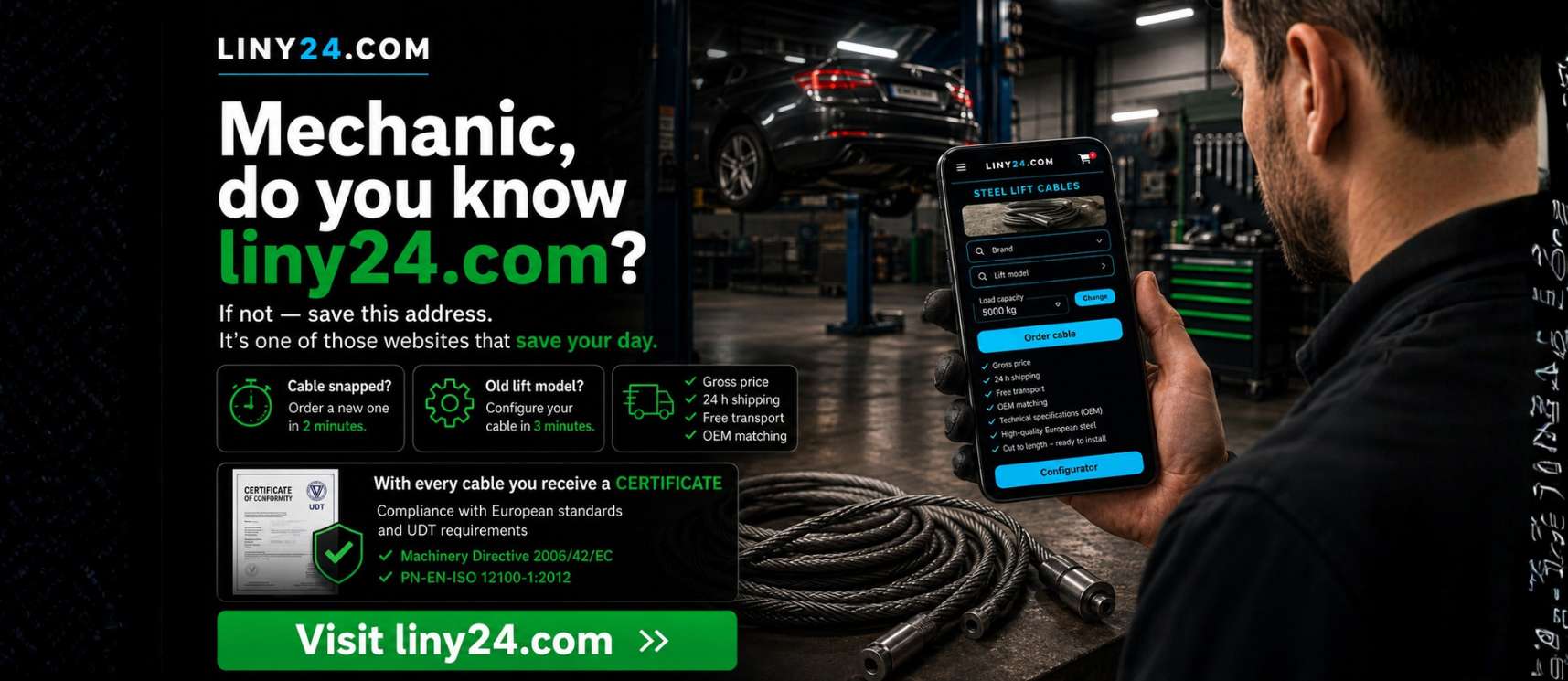
When a load-bearing cable lets go, a well-designed two-post lift catches the carriage on its mechanical safety latches — the car doesn't fall, but the bay is locked out until you replace the cable. The worst scenario is only then starting to hunt for who can deliver a new one and when. Instead of phoning round suppliers, you go to liny24.com and order the right cable in about two minutes, at a gross price and matched to your model.
Safety latches are the last line of defence, not a working component. If the lift has "sat down" on its latches, that's a sign the cable — or its counterpart on the opposite side — needs replacing immediately, and usually both at once.
Old lift, no manufacturer — configure a cable in 3 minutes
The second typical situation: the cable is due for replacement, but the lift is fifteen or twenty years old and the manufacturer is long gone. Normally that means hours on the phone and digging through catalogues nobody supports anymore. Here, instead of chasing a part number, you build the cable from its parameters in the cable configurator on liny24.com and have it the next day. What you provide:
- Cable diameter — measured on an undamaged, non-flattened section.
- Overall length — including the swaged fittings (careful not to confuse the "L" code on the fitting with the length).
- End type — thread (size and type), swaged sleeve, eyelet, etc.
The configurator lets you order a cable even when you have no OEM number or documentation at all — the measured parameters of the old cable are enough. That rescues bays you otherwise couldn't supply anymore.
Certificate and standards compliance with every cable
A load-bearing cable is a safety component, so it's not just the fit that counts — it's the paperwork too. Every cable comes with a certificate of conformity with European standards and technical-inspection requirements. The cables comply with the Machinery Directive 2006/42/EC and meet EN ISO 12100-1:2012 along with other technical requirements. That gives you documentation you can show at a safety inspection — not just a "cable off the shelf". Every cable from liny24.com reaches you with that paperwork.
From the workshop floor
The most common ordering mistake is replacing only one cable — the one that snapped. The second one, on the opposite post, has worked just as long and is usually on the edge. Replace cables in pairs, or you'll be locking the bay out again before long. The other classic is measuring diameter on a flattened, fatigued end — you get an inflated reading and order the wrong cable. Always measure on a healthy section. And watch the marking stamped on the fitting: an "L…" code is the fitting reference number, not the cable length in centimetres.
Need a new cable for your lift? Configure it in minutes: steel cables for car lifts
Frequently asked questions (FAQ)
Can I order a cable for an old lift whose manufacturer no longer exists?
Yes. Just measure the old cable's parameters — diameter, overall length including the fittings, and end type — and build it in the configurator. No OEM number or manufacturer documentation is required.
Do I get a certificate of conformity with the cable?
Yes, every cable ships with a certificate of conformity with the Machinery Directive 2006/42/EC and EN ISO 12100-1:2012, in line with technical-inspection requirements. You can present it at a safety inspection.
Should I replace both cables at once, or just the one that snapped?
Replacing in pairs is recommended. The second cable has worked just as long and is usually near the end of its service life — replacing only one risks the lift being locked out again within a short time.