




Leave feedback on the product


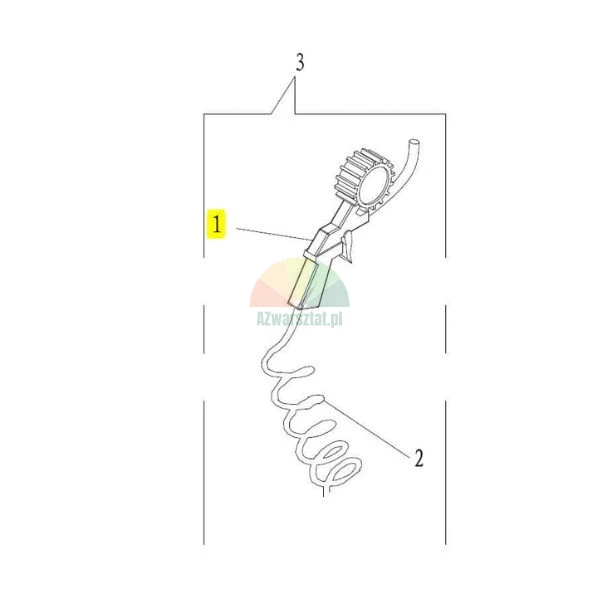
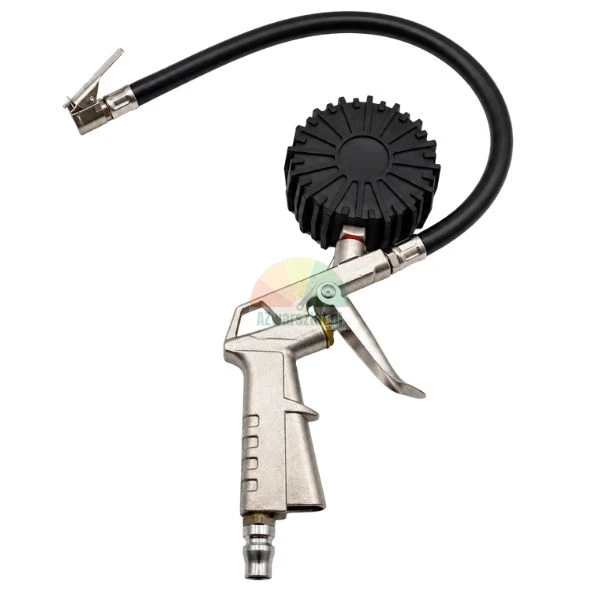
TYPE A inflation gun

Shipping costs are not included in the price.
Shipping costs are not included in the price.
Product code: M-PIST-0001
Share the product card


Ask about the product
The personal data controller is Graf-Art Sławomir Kulbida. We process it to respond to the inquiry. More information about the processing of personal data can be found in the privacy policy.

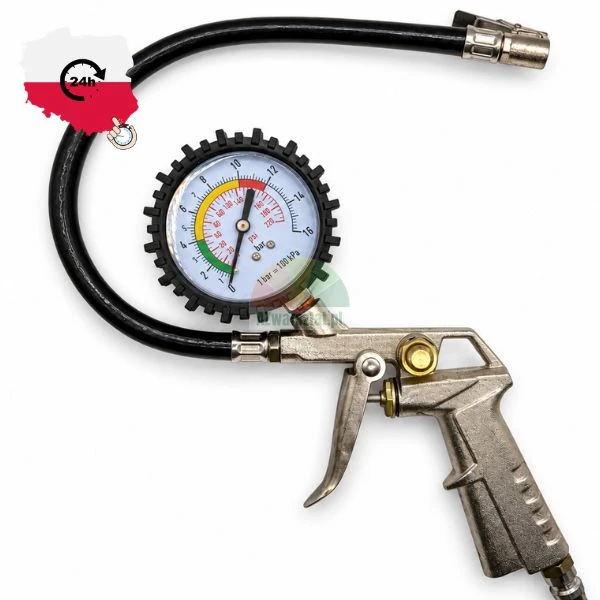
TYPE A tyre inflator with pressure gauge
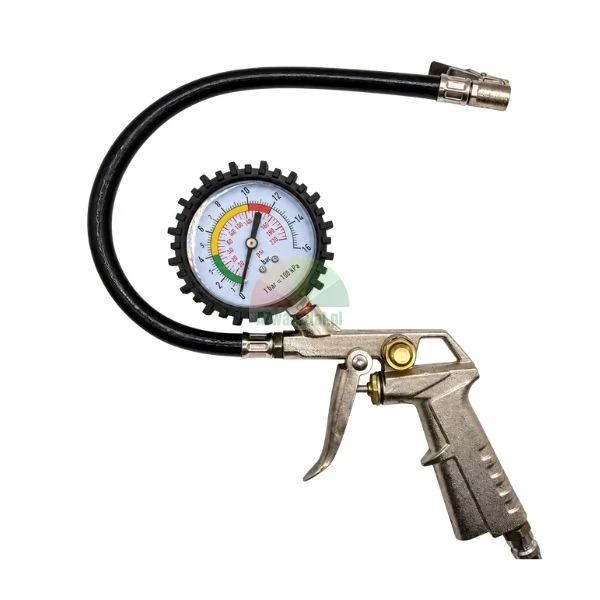
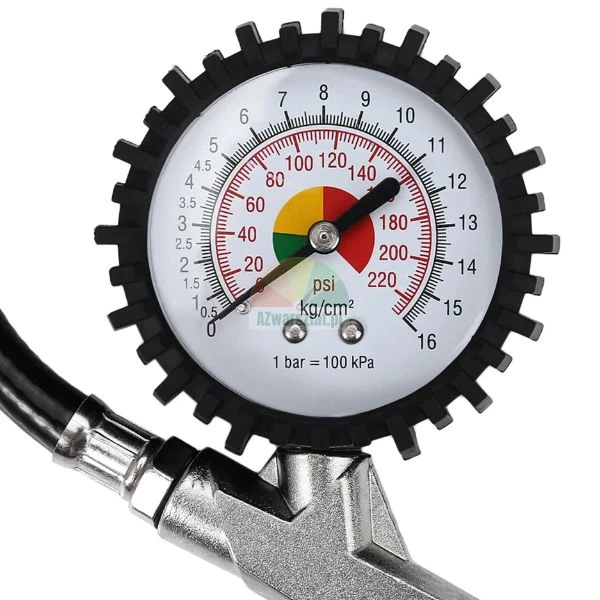
A pneumatic tyre inflator for checking and topping up tyre pressure. The integrated pressure gauge allows you to read the pressure without removing the nozzle from the valve, whilst the lever on the handle regulates the air flow from the system.
The gun connects to a compressor fitted with a pneumatic hose terminated with a suitable quick-release coupling. The flexible hose, approximately 35 cm long, facilitates access to the valve, particularly on the wheels of passenger cars, vans and workshop machinery.
Technical specifications
| Type | TYPE A inflation gun |
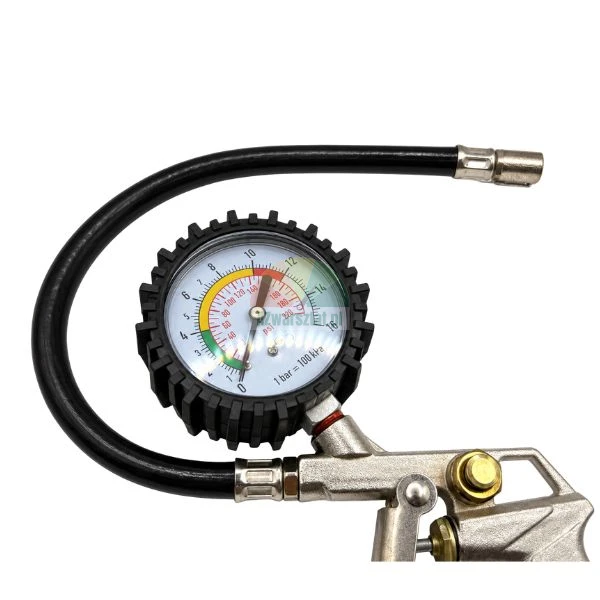
| Pressure gauge | Analogue, dial diameter approximately 7.3 cm |
| Hose length | Approx. 35 cm |
| Handle length | Approx. 13 cm |
| Connection | Pneumatic, for connecting the supply hose |
Workshop application
The gun is ideal for monitoring pressure whilst working on tyres, preparing wheels after tyre fitting, and adjusting pressure before the vehicle is released. This design allows the pressure gauge reading to be taken whilst air is being supplied, without the need for a separate gauge.
When adjusting the pressure, the hose nozzle must be securely seated on the valve. If air escapes from the valve, the pressure gauge reading may change faster than the actual tyre pressure, and the operator may over-inflate the tyre unnecessarily.
Practical check: once inflation is complete, release the lever and read the pressure when the air flow has stopped. The reading taken whilst the tyre is being inflated rapidly may temporarily differ from the stabilised pressure in the tyre.
What to look out for during use
- Pressure gauge: striking the body against the ground or a part of the machine may throw the pointer mechanism out of alignment, even if the dial and glass remain intact. If the pointer consistently fails to return to its resting position, or if it shows values for the same tyre that are clearly different from those of a second gauge used for comparison, the nozzle must be checked.
- Hose: damage most commonly occurs at the clamps and where the hose is repeatedly bent near the body. A leak in this area reduces pumping efficiency and may cause unstable readings.
- Valve nozzle: a worn or dirty nozzle may not seal properly against the valve insert. Symptoms include a hissing sound upon connection and the need to press the hose firmly into place to maintain flow.
- Pneumatic connection: a loose connection on the supply side causes a constant loss of air from the system and increases the pumping time. In a workshop, this may also cause the compressor to cycle on and off more frequently.
Pressure should not be set solely on the basis of the position of the needle relative to the coloured zones on the dial. The target value should be selected according to the specifications for the specific vehicle, axle and load, and the pressure gauge should be cross-checked against another verified instrument.
Selection and fitting
Before connecting, check that the quick-release coupling on the workshop hose fits the connection on the nozzle handle. Do not force parts with different profiles into the connection, nor apply lateral force to the connection whilst working. The gun should be connected to a system with parameters suitable for the pneumatic equipment being used.
The hose must be routed so that it is not crushed by a wheel, a jack or any workshop equipment. Restricting the hose’s cross-section reduces air flow, whilst pulling on the hose may loosen the clamp at the body or the nozzle.
This product is designed for workshop-based tyre pressure checks and adjustments using a compressed air system.
Product safety
Responsible person in the EU
Graf-Art Sławomir Kulbida
ul. Bolesława Chrobrego 38/5
59-700 Bolesławiec, Poland
Importer
Graf-Art Sławomir Kulbida
ul. Bolesława Chrobrego 38/5
59-700 Bolesławiec, Poland
Opinions
If you've added a review and it doesn't appear on the list, it may be pending moderation.
Leave feedback on the product
It pairs well


Do you need help?

Go to the blog.
Talk to our customer service team.
Monday to Friday from 9:00 AM to 3:00 PM.
Frequently Asked Questions
What cables do I need for my two-post lift?
Check the rope termination. If there are any markings on it, the total rope length is very often indicated as well, e.g., L8920. This means the rope length is 8.92 m.
Additionally, to correctly select the rope, you need to provide the following technical parameters:
- Rope diameter – measured in the middle section (e.g., 8 mm, 9 mm or 10 mm)
- Thread – diameter (e.g., M16)
- Thread – length – length of the threaded section (e.g., 14 cm)
The drawing below shows the parameters that must be provided when ordering the rope:
What is my machine's model?
- Find the nameplate on the device – it usually contains key information, such as:
- Manufacturer
- Device model
- Year of manufacture
- Serial number
- If you cannot find the nameplate and do not have the technical documentation, selecting parts based on the model may be difficult. In this situation, we recommend searching for parts by category, photos, and dimensions, which often allows you to precisely match the correct component.
Can I return or exchange the part if it doesn't fit?
If the ordered part doesn’t fit, you can return or exchange it within 30 days of the purchase date.
For the return to be accepted, the part must:
- be unused and undamaged,
- show no signs of installation,
- be sent back in its original or appropriately secured packaging.
We care about your shopping experience, so the return process is quick and hassle-free. If you have any doubts, contact us – we’ll be happy to help you choose the right part or guide you through the return process.

