




Leave feedback on the product


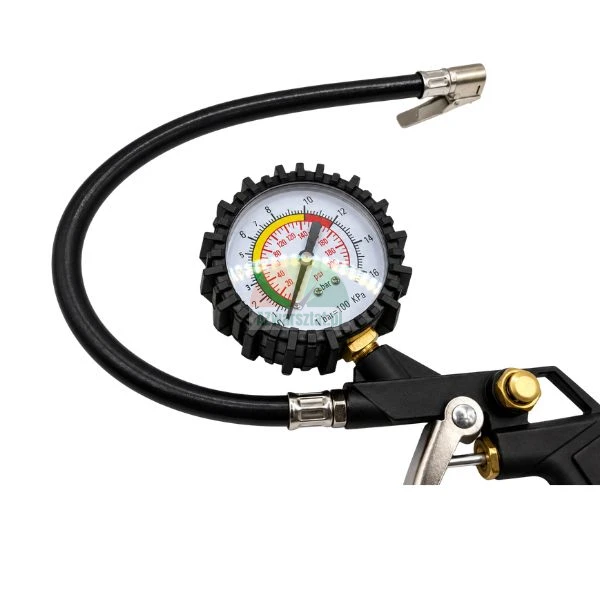
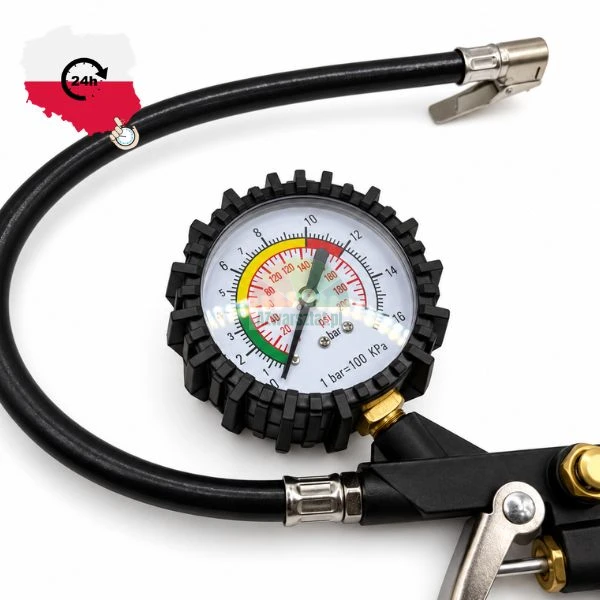
Inflator gun 0–16 bar

Shipping costs are not included in the price.
Shipping costs are not included in the price.
Product code: M-PIST-0004
Share the product card


Ask about the product
The personal data controller is Graf-Art Sławomir Kulbida. We process it to respond to the inquiry. More information about the processing of personal data can be found in the privacy policy.

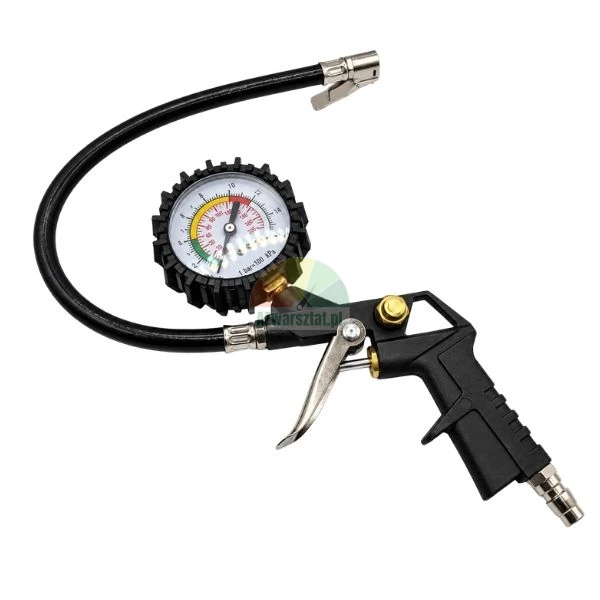
Tyre inflator (0–16 bar) with pressure gauge
Pneumatic gun for checking, inflating and deflating tyres. The integrated analogue pressure gauge allows you to read the pressure without removing the nozzle from the valve. The gun is compatible with a compressed air system and is designed for use on passenger cars, vans, motorbikes and other vehicles fitted with standard car valves.
Technical specifications
| Pressure gauge range | 0–16 bar |
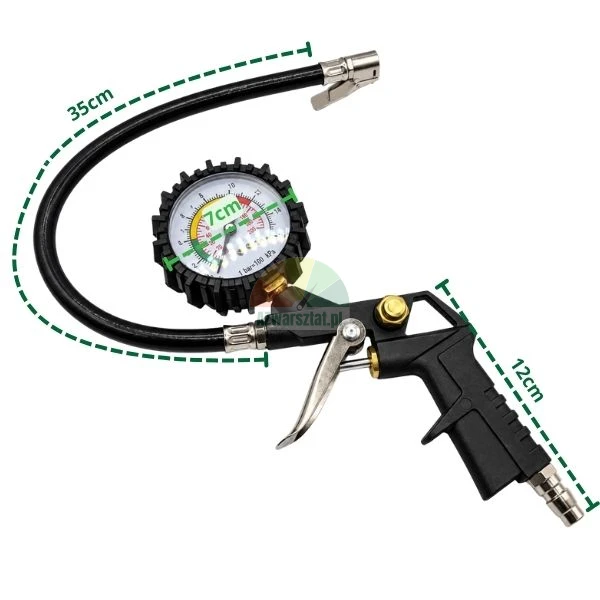
| Pressure gauge dial diameter | approximately 7 cm |
| Hose length | approx. 35 cm |
| Handle length | approx. 12 cm |
| Display type | analogue pressure gauge |
| Working end | clamp-on tyre valve nozzle |
For workshop use
The gun’s lever allows you to regulate the air flow, whilst the pressure gauge displays the pressure in the circuit when the nozzle is connected. Thanks to the approximately 35 cm long hose, you can read the gauge from a safe position without having to bend the gun body towards the wheel.
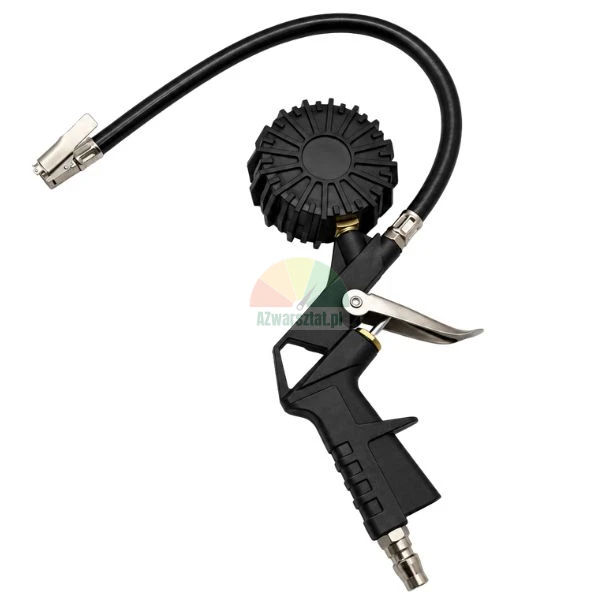
The protective cover around the pressure gauge dial minimises the effects of accidental impact with the wheel rim or workshop equipment. However, it does not protect the measuring mechanism against overload resulting from applying a pressure higher than that permitted for the tool.
The 0–16 bar range is the pressure gauge’s scale. It should not be treated as the recommended tyre pressure. When in use, the pressure specified by the vehicle, tyre and wheel rim manufacturers must be observed. The instructions for this type of inflation gun also recommend checking the pressure gauge reading before starting work and stopping use if the needle does not return to zero.
Signs of wear or a leak
- the needle remains away from the zero position after the nozzle is disconnected,
- the reading changes in jerks rather than responding smoothly to pressure,
- the nozzle needs to be pressed down constantly to prevent air escaping from the valve,
- when the lever is closed, a constant hissing sound can be heard from the body, hose or connection,
- the reading differs from that of a calibrated service pressure gauge when used on the same tyre.
The problem most commonly arises at the seal of the clamping nozzle, at the hose crimp point and in the gun’s control valve. Contaminants and condensation from the compressed air system can cause the valve to stick, whilst the pressure gauge striking hard surfaces can throw the mechanism out of calibration even if there is no visible crack in the dial.
Selection and operation
- Before taking a measurement, ensure that the nozzle is fully seated on the valve; partial engagement will result in air leakage and an unstable reading.
- Do not pull on the hose when removing the nozzle. Repeated bending at the metal clamps shortens its service life and may cause leaks.
- Once connected, check the behaviour of the pointer before starting to pump. If it does not return to zero, the pressure reading will be inaccurate.
- Do not use the gun as a permanent part of the system, nor leave it under pressure when not in use.
- Water and oil from an incorrectly prepared pneumatic system accelerate wear on the valve and seals.
For low-profile tyres, van tyres or tyres inflated to higher pressures, it is advisable to compare the reading on this nozzle with a reference pressure gauge. A worn or out-of-calibration pressure gauge may result in incorrect pressure settings across all wheels being serviced, even though the tyre itself is not leaking.
Product safety
Manufacturer
Graf-Art Sławomir Kulbida
ul. Bolesława Chrobrego 38/5
59-700 Bolesławiec, Poland
Opinions
If you've added a review and it doesn't appear on the list, it may be pending moderation.
Leave feedback on the product
It pairs well


Do you need help?

Go to the blog.
Talk to our customer service team.
Monday to Friday from 9:00 AM to 3:00 PM.
Frequently Asked Questions
What cables do I need for my two-post lift?
Check the rope termination. If there are any markings on it, the total rope length is very often indicated as well, e.g., L8920. This means the rope length is 8.92 m.
Additionally, to correctly select the rope, you need to provide the following technical parameters:
- Rope diameter – measured in the middle section (e.g., 8 mm, 9 mm or 10 mm)
- Thread – diameter (e.g., M16)
- Thread – length – length of the threaded section (e.g., 14 cm)
The drawing below shows the parameters that must be provided when ordering the rope:
What is my machine's model?
- Find the nameplate on the device – it usually contains key information, such as:
- Manufacturer
- Device model
- Year of manufacture
- Serial number
- If you cannot find the nameplate and do not have the technical documentation, selecting parts based on the model may be difficult. In this situation, we recommend searching for parts by category, photos, and dimensions, which often allows you to precisely match the correct component.
Can I return or exchange the part if it doesn't fit?
If the ordered part doesn’t fit, you can return or exchange it within 30 days of the purchase date.
For the return to be accepted, the part must:
- be unused and undamaged,
- show no signs of installation,
- be sent back in its original or appropriately secured packaging.
We care about your shopping experience, so the return process is quick and hassle-free. If you have any doubts, contact us – we’ll be happy to help you choose the right part or guide you through the return process.

